
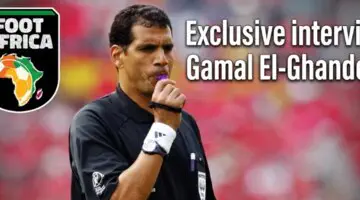
Exclusive for FootAfrica: "Even if 100 years pass, I would not change my decisions!" Al-Ghandour stands by the decisions he previously made
Exclusive
Gamal El-Ghandour: The Egyptian referee who took charge of one of the most debated matches in World Cup history — South Korea versus Spain in 2002 — and who, more than two decades later, still insists he got every call right.
Over a long international career that began in 1996, he officiated at the Olympic Games, the World Cup, Euro 2000 and the Confederations Cup, becoming the first referee from outside Europe to work at a European Championship. In this exclusive interview with FootAfrica.com, he revisits that controversial quarter-final, responds to years of Spanish criticism, and shares his views on VAR, Pierluigi Collina and Uzbek refereeing.
Early Career and Proudest Achievements
– In the early 2000s, you were one of the most recognisable referees in world football. Looking back on your career, which achievement are you most proud of, and which moment would you most like to experience again?
– First of all, thank you very much for your interest. I am particularly proud of having officiated at the 1998 FIFA World Cup in France and subsequently at UEFA Euro 2000. Taking part in several major international tournaments was one of the greatest achievements of my refereeing career.
However, I would like to emphasise that my refereeing career and international achievements are not limited to the events mentioned in your questions. Therefore, I would appreciate it if you could also cover my entire international refereeing career, which began in 1996, to provide a more comprehensive and objective picture of my experience.
My international career began with my participation in the 1996 Olympic Games in Atlanta. I officiated as a referee in four matches at that tournament, including the quarter-final and the third-place play-off.
In 1998, I took part in the FIFA World Cup in France, where I officiated in three matches. The most significant of these was the quarter-final between Brazil and Denmark.
In 2000, I participated in Euro 2000 and became the first referee from outside Europe to officiate at the European Championship. I took charge of two matches at that tournament.
In 2001, I participated in the FIFA Confederations Cup, where I officiated in two matches, including the semi-final between Brazil and France.
Then, in 2002, I took part in the FIFA World Cup held in South Korea and Japan. I officiated in three matches as the referee, including the quarter-final between South Korea and Spain.
The 2002 Quarter-Final: Decisions Under the Microscope
– The quarter-final between South Korea and Spain at the 2002 World Cup remains one of the most controversial matches in the history of the tournament. More than two decades have passed. How do you remember that game today?
– I would particularly like to clarify two important incidents from that quarter-final, which have been widely discussed over the years.
In the first incident, my assistant referee signalled that the ball had gone out of play over the goal line, passing above the goalpost. He indicated that a goal kick should be awarded. Based on his signal, I blew my whistle and awarded a goal kick. However, it later became clear that the ball had actually remained in play. Therefore, the mistake was not mine as the referee, but that of the assistant referee, who misjudged the situation.
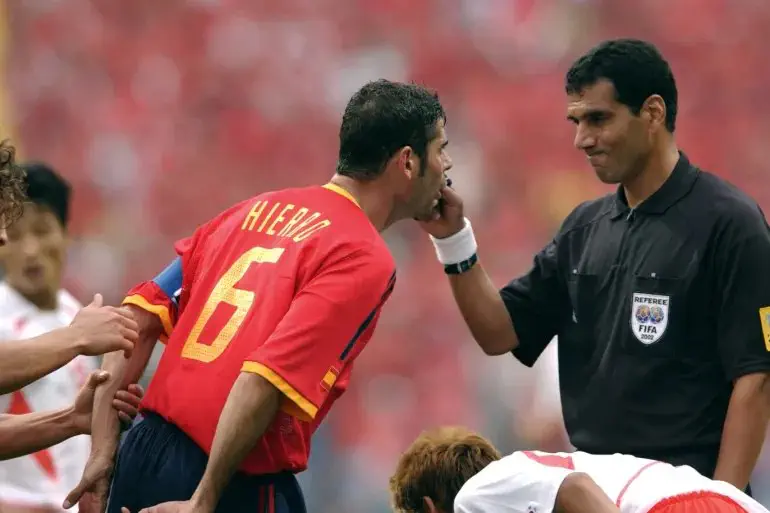
In the second incident, a Spanish forward pushed a South Korean defender from behind and pulled his shirt. I correctly decided to stop play for a foul. Only after that did the ball enter the goal. Consequently, the goal was disallowed because the whistle had already been blown.
I remember that match very well. Even if a hundred years were to pass, I would remain absolutely convinced that I made no refereeing mistakes in that game.
Regarding the first incident, my assistant referee indicated that the ball had gone out of play over the goal line, passing above the goalpost. Therefore, a goal kick had already been awarded before the Spanish player put the ball into the net.
As for the second incident, I judged that there had been a clear foul involving a push and a shirt pull before the ball went into the goal past the defender. For that reason, I do not accept responsibility for these decisions.
– During that match, did you feel any pressure from the home supporters, the tournament organisers or anyone else? Were there any attempts to influence your decisions?
– Absolutely not! On the contrary, the fans were wonderful, and the atmosphere in the stadium was excellent. I felt no pressure whatsoever from the home supporters.
– After the match, you faced severe criticism, particularly from the Spanish media and fans. How did you respond to that criticism? Did it affect your personal life or professional career?
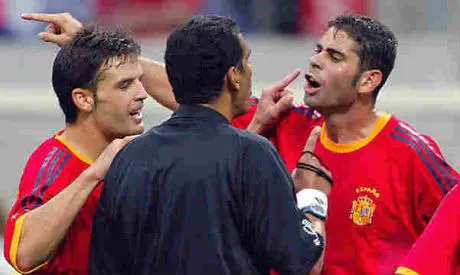
– I faced intense criticism for a very long time, for more than 18 years. Eventually, I requested an opportunity to meet the person responsible for refereeing matters in Spain. I wanted to discuss face-to-face the mistakes I had been accused of making. Finally, that meeting took place in 2018.
Following those incidents, I was criticised by the Spanish media and supporters. They believed that I had made incorrect decisions against their national team. This criticism continued for many years, even until 2018.
Nevertheless, I believe it is important to present these incidents in their proper and original context, particularly when discussing my overall refereeing career and the decisions made during that match. I hope this additional information will help you provide a more comprehensive and objective picture of my international refereeing career and achievements.
– After that match, did you ever speak to any Spanish players or officials about the game? If so, what was their attitude towards you?
– Apart from the person responsible for refereeing matters in Spain, I never discussed that match with any Spanish national team players or officials.
In 2018, I travelled to Spain and debated those decisions live on television with the head of Spanish refereeing who had accused me of making those mistakes. He fully acknowledged that I was not responsible for the alleged errors.
The television channel agreed to my condition that I should have a face-to-face discussion with the Spanish refereeing representative. The interview attracted considerable attention. Later, representatives of the channel told me that the programme had significantly changed public opinion in Spain.
– Do you think the absence of VAR at the 2002 World Cup played a decisive role in those controversial incidents? Would those situations have been judged differently if today's technology had been available?
– Yes. If VAR had existed at the time, there would have been an opportunity to review those incidents.
– If you could go back to the 2002 South Korea–Spain match and change just one decision, would you take that opportunity, or do you still believe that every decision you made that evening was correct?
– No. I would not change a single decision. The decision concerning whether the ball had gone out of play was made by my assistant referee, who was in the correct position. An assistant referee's judgement must be respected when determining whether the ball has crossed the line. As for the second incident, in my view, the foul was clear. Even if I were given the opportunity to referee that match again, I would make exactly the same decision.
read more: Foot-Africa exclusive – AFCON 2027: “Everyone says it’s impossible to hold”, warns Romain Molina
Refereeing Philosophy, VAR and the Modern Game
– Pierluigi Collina was one of the most famous referees of your generation. How would you compare your refereeing philosophy with his approach? What set Collina apart from other referees?
– The Laws of the Game are applied in the same way by all referees. What distinguishes one referee from another is physical fitness, strong character and the ability to manage a match.
Pierluigi Collina was undoubtedly one of the greatest referees. However, there were other outstanding officials of his generation, such as Ali Bujsaim of the UAE and Said Belqola, who refereed the 1998 World Cup final.
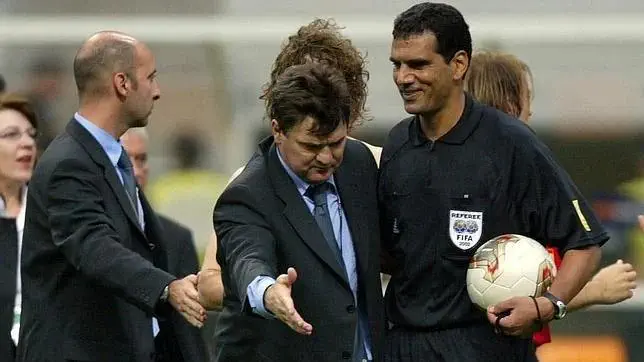
– During your career, did you ever find yourself apologising for a decision after being criticised by a player or public figure? Conversely, have you ever wanted to apologise for one of your own decisions?
– No. There is no particular decision for which I believe I should apologise. Before the introduction of VAR, refereeing was based on the human factor and individual judgement. Human errors were part of football. As the FIFA president at the time also pointed out, such mistakes were one of the elements that made football interesting.
– Modern referees work under enormous pressure. Every decision is analysed through dozens of cameras. In your opinion, has VAR made refereeing easier, or has it actually increased the pressure on officials?
– VAR has created an opportunity to correct serious refereeing errors during a match. Decisions can be reviewed and changed when necessary. This has significantly strengthened fairness and impartiality in football.
– Who do you consider the best referee in the world today?
– In my opinion, the best referee in the world at the moment is England's Michael Oliver.
Uzbek Refereeing, Ravshan Ermatov and Life After the Whistle
– What does the record for the most matches officiated at FIFA World Cups by a referee say about Uzbek refereeing?
– The record for the most matches officiated at FIFA World Cups belongs to Ravshan Ermatov of Uzbekistan. This is clear evidence that refereeing in Uzbekistan has developed and reached a high standard.
– So, you know Ravshan Ermatov well?!
– Yes, of course. Ravshan Ermatov is a great referee and holds the record for the most matches officiated at FIFA World Cups.
– In general, what do you know about Uzbekistan and its football?
– Uzbekistan is one of the strong footballing nations in Asia. Its national team competes for a place at the FIFA World Cup, and the country has also produced several outstanding referees. Ravshan Ermatov is a particularly remarkable example of this.
– What inspired you to become a football referee?
– It happened by chance. However, I progressed quickly in refereeing, managed to prove myself and established my position in the profession.
– What have you been doing since ending your refereeing career?
– After retiring from refereeing, I worked as a FIFA international instructor. I also spent many years overseeing and managing refereeing matters in my own country. In addition, I was a member of the Referees Committee of the Arab Football Federation. I also worked in sports media for major television channels, particularly beIN Sports.
– Thank you for your answers!
– It was a pleasure and an honour for me to take part in this interview. I hope I have answered your questions adequately.


Interviews
Today at 09:07

AFCON
10 November 2026
Africa
09 November 2026
Africa
09 November 2026
Europe
06 November 2026