
Every two years or three years? The new CAF calendar raises questions about the future of the Africa Cup of Nations
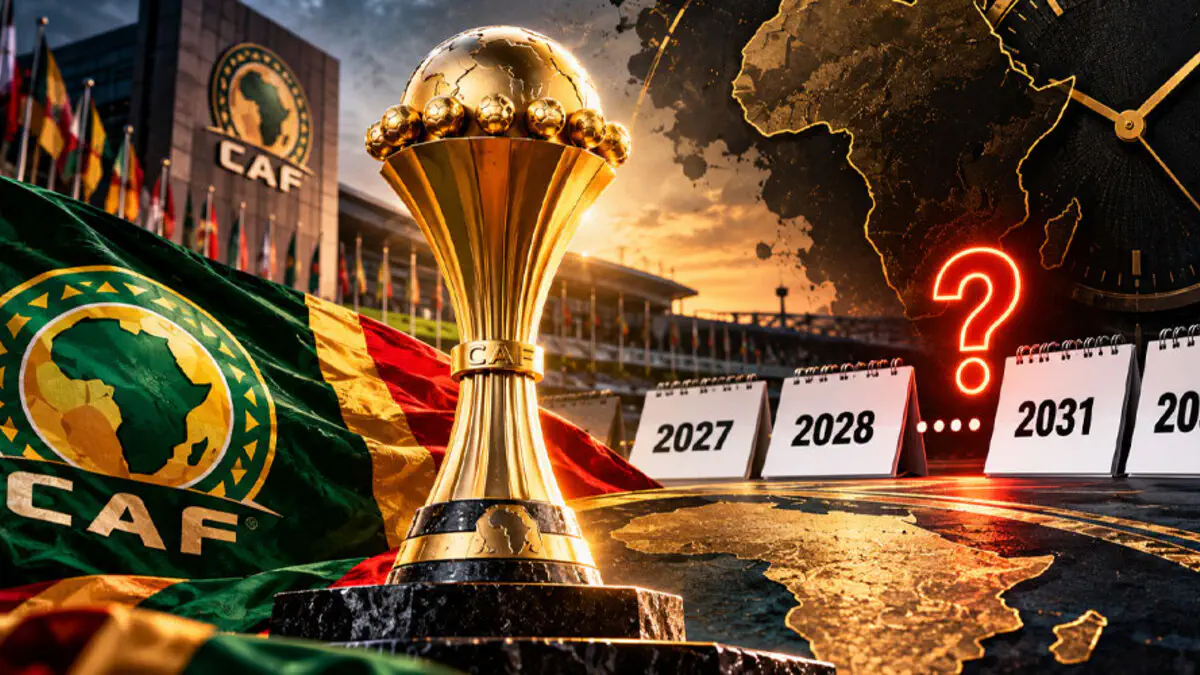
The Confederation of African Football CAF has officially restored the Africa Cup of Nations to a two year cycle but its newly announced tournament calendar has raised questions about how the decision will be implemented.
On Thursday 29 October CAF confirmed that its Executive Committee had unanimously reversed the controversial 4 year format announced in December 2025.
However, while the governing body described its decision as a return to the traditional biennial system, the next four editions are scheduled for 2027, 2028, 2031 and 2033.
The announcement creates an apparent contradiction: if AFCON is returning to a 2 year cycle, why will 3 year separate the 2028 and 2031 tournaments?
CAF reverses its 4 year AFCON decision
According to CAF's official statement, the Executive Committee unanimously approved the return to a biennial Africa Cup of Nations following a reassessment of its competition strategy.
The reversal comes just 10 month after CAF announced plans to stage its flagship tournament every 4 year following the 2028 edition.
That original proposal was intended to restructure the African international calendar and introduce a new African Nations League.
However, the decision attracted criticism over its potential impact on national teams, commercial opportunities and the importance of AFCON within African football.
As Foot Africa previously reported, Patrice Motsepe reopened discussions over the tournament's frequency during CAF's strategy conference in Cape Verde earlier this month.
The 29 October announcement has now formally reversed the four-year plan.
Nevertheless, the revised calendar has introduced a different scheduling question.
AFCON 2027, 2028, 2031 and 2033: What do the dates reveal?
CAF confirmed four upcoming editions but the intervals between them are not consistent.
The announced schedule is:
- AFCON 2027: Kenya, Tanzania and Uganda.
- AFCON 2028: One year after the previous edition.
- AFCON 2031: Three years after the 2028 tournament.
- AFCON 2033: Two years after the 2031 edition.
The most striking feature is the gap between 2028 and 2031.
A strictly biennial calendar beginning in 2027 would ordinarily produce editions in 2029, 2031 and 2033.
Alternatively, a 2 year cycle beginning in 2028 would suggest tournaments in 2030, 2032 and 2034.
CAF's announced sequence follows neither pattern consistently.
The governing body explained that AFCON would not be staged in 2030 because the FIFA World Cup will take place that year.
However, its statement did not explain why 2029 was absent from the announced calendar or how the competition would transition into a regular 2 year schedule.
This distinction is important: the 3 year gap does not establish that CAF has adopted a triennial tournament.
Rather, it indicates that the announced transition timetable remains uneven despite the official return to a biennial policy.
Why did CAF abandon its four year plan?
Financial considerations played an important role in the latest reversal.
CAF had previously proposed establishing an African Nations League to provide regular international competition and generate additional revenue for its member associations.
The project was presented as a central element of the restructuring announced by Motsepe in December 2025.
However, CAF has now acknowledged that the proposed competition would require several years to generate the financial resources necessary to support African football.
Motsepe explained that retaining AFCON's traditional frequency would help protect the interests of the continent's 54 member associations and African footballers employed by overseas clubs.
The decision underlines the competition's economic importance.
AFCON is not simply a continental championship. It also provides commercial exposure, broadcasting opportunities and financial benefits for national associations.
Reducing the number of editions could therefore have consequences extending beyond the international match calendar.
The unanswered question is what happens to the African Nations League following the latest reversal.
CAF has not yet provided a detailed replacement calendar explaining whether the proposed competition will continue in its original form, be redesigned or undergo further changes.
What does the new schedule mean for host nations?
The revised timetable also raises questions about the long term organisation of the tournament.
In July 2026, CAF officially invited its member associations to submit bids for the 2028, 2032 and 2036 editions.
As Foot Africa reported when the bidding process was launched, the initiative formed part of the governing body's 4 year competition strategy.
However, the October announcement identifies 2028, 2031 and 2033 as the next editions following AFCON 2027.
This creates uncertainty surrounding the previously announced hosting framework.
CAF has not explained how the existing bidding process will be adapted or whether applications associated with the 2032 and 2036 tournaments will need to be reconsidered.
For prospective hosts, a stable calendar is essential.
Organising AFCON requires substantial investment in stadiums, transport networks, accommodation and security infrastructure.
Countries considering bids need sufficient time to assess costs, secure financing and complete preparations.
Repeated changes to the tournament schedule can therefore complicate long term planning, particularly when host selection processes have already begun.
Will AFCON 2027 be affected?
For now, the next tournament remains unchanged.
The 2027 Africa Cup of Nations will take place from 19 June to 17 July, with Kenya, Tanzania and Uganda jointly hosting the competition.
It will be the first edition organised by three countries.
Qualification is already underway, with the final qualifying matches scheduled for March 2027.
The revised competition cycle does not alter those confirmed arrangements.
However, the subsequent edition in 2028 will follow just one year later, creating a relatively short interval between consecutive continental championships.
That proximity could raise additional questions about qualification schedules, player workload and preparations for participating national teams.
These issues will require further clarification once CAF publishes a more detailed competition calendar.
What happens next? CAF faces questions over its transition plan
CAF's decision to preserve the Africa Cup of Nations as a biennial competition settles the debate over whether the tournament should permanently move to a four year format.
But it does not resolve every scheduling issue.
Three questions remain particularly important:
- Why the tournament will not be staged in 2029?
- How the previous hosting bids will be accommodated?
- What role the proposed African Nations League will play under the revised structure?
The governing body's next challenge will be to explain how the announced editions fit into a sustainable long term schedule.



AFCON
Today at 04:34

Africa
Yesterday at 15:34


Africa
Yesterday at 04:00

Europe
28 October 2026

Africa
25 October 2026

Exclusive
17 October 2026

Africa
14 October 2026

Europe
12 October 2026